
Past courses and other resources
Study Group: Four Doors to Meeting for Worship with Simonne Wood
William Taber’s Pendle Hill Pamphlet ‘Four Doors to Meeting for worship’ offers deeply spiritual but practical guidance for our attempts to pay attention to the Divine. His advice encompasses not only the time of shared worship itself, but also the vital role that preparation and mindful departure play in the quality and depth of our worship.
William Taber believed that there were 4 doors to Meeting for Worship
1) The Door Before (preparation during the week and before meeting for worship)
2) The Door Inward (settling into worship)
3) The Door Within (what is a gathered meeting for worship?)
4) The Door Beyond (at the end of meeting for worship).
Over the first four weeks of this course, we will discuss each of the four ‘doors’ recommended by Taber, accompanied by a few pages of preparatory reading and reflection to complete before each live session. You’ll also be encouraged to put some of his advice into practice and reflect on the experience with other participants. The final session, in January, will be an opportunity to review together what we have learnt and whether we have experienced a difference in the quality of our worship as a result.
This course will have something to offer to those who are just discovering the Quaker way of worship, as well as to those who have been worshipping as Friends for years – there is always room for deepening our relationship with the Divine through worship.
We will post a paper copy of the pamphlet to each participant before the beginning of the course. This is included in the course fee of $75. Please note that we offer educational grants to those who experience financial hardship with the fee.
The course is taught synchronously using Moodle, but will be recorded for people who need to be elsewhere. Recordings are posted several days after the synchronous session.
This course is taught by Simonne Wood from the Woodbrooke Quaker Study Centre.
Dates: Wednesdays in November: 5, 12, 19, 26 & follow-up session January 28
Start time: 9 am Pacific, 10 am Mountain, 11 am Central, 12 pm Eastern, 1 pm Atlantic.
The registration deadline is October 17, allowing for the timely mailing of the pamphlet.
What Happens When We Worship Online?
What Happens When We Worship Online? – Course information and registration
Tutors:
Rhiannon Grant is Woodbrooke’s Deputy Programme Leader for Research and Programme Coordinator for Modern Quaker Thought.
Simonne Wood is Woodbrooke’s Programme Coordinator for Worship & Spirituality.
Join us for a series of sessions online where we will reflect on the essence and meaning of Quaker worship in the unprogrammed tradition, and consider how meeting online challenges or reshapes our assumptions.
Together, we will explore:
- The theology of online worship, asking questions such as “Where is the Spirit?” and “What is a gathered meeting?”
- How different Friends experience online worship
- The current and future impact of online worship on Quaker faith, practice, and community
This course will deepen your understanding and experience of meeting for worship, whether online or in person. It is also a valuable resource for those responsible for the quality of worship, helping to explore the role of online worship within your community. We will discuss both blended and fully online meetings for worship.
Course Cost: $50, which can be paid by credit card at the end of the registration form linked below.
Deepening Quaker Community with Ben Pink Dandelion
‘Deepening Quaker Connection’
Would you like to know more about how Quakers organize their religious business matters? What does it take to become a Clerk of a Meeting? And how do we serve well on a committee or handle a difficult decision? We invite you to these sessions that will focus on deepening how we work together as Quakers.
Woodbrooke Quaker Learning and Research Centre tutor Ben Pink Dandelion will be leading 4 online sessions focusing on Quaker corporate discernment:
1) What is the Quaker business method? What are we trying to do and why do we use the process we do?
2) Clerking and being Clerked; how we can best nurture our worship for church affairs?
3) Quaking with Confidence; an exploration of service and role holding.
4) Difficult issues: how do we deal with difficult questions such as property?
Dates and times:
Four Wednesdays in 2024: 2 October; 9 October;16 October; 23 October
Times are: 9:00 -10:30 PDT; 10-11:30 MDT; 11:00-12:30 CDT; 12:00-1:30 EDT; 1:00-2:30 ADT; 5:00-6:30 GMT (UK)
Each 1.5 hour session will be recorded and available several days after the class or access the video recordings at a later date.
Cost: $50 Canadian
This event is hosted by Canadian Yearly Meeting; please contact: for more information.
Renewing Quaker Community with Ben Pink Dandelion
‘Renewing Quaker Community with Ben Pink Dandelion – Course details – 2024
Canadian Yearly Meeting Education & Outreach and Woodbrooke Quaker Studies are partnering to bring Canadian Friends: Renewing Quaker Community with Ben Pink Dandelion
Does it ever feel like Quakers are shrinking?
Have you felt frustrated that there is more we can do as Quakers to spread the light? Do you want to gain momentum?
Please consider Renewing Quaker Community with Ben Pink Dandelion
In this workshop led by UK Woodbrooke Quaker Studies tutor and author Ben Pink Dandelion, we’ll explore heartfelt moments of exploration around our Quaker communities. Ben will share his deep-felt experience with Quaker faith and practice over many decades. We will also share ideas on how Meetings might gain some momentum on renewal at a time of great change. We’ll be reflecting together on some of the essential parts of the Quaker tradition in small group discussions.
This workshop is comprised of four sessions that will be approximately 1.5 hours in duration.
Event dates:
January 13, 2024
February 17, 2024
March 16, 2024
April 20 2024
Quaker Basics with Jackie Bonner
‘Quaker Basics Course details – April & May 2024’
The Quaker Basics course is an educational course about Quakerism offered by Canadian Yearly Meeting and Jackie Bonner, which has had several successful previous iterations. This course is not running in 2025.
This is a Friendly (pun intended) course for people interested in learning about Quakers and the ways of Canadian Friends. The course is meant to be an experience, more so than an academic course. There is no testing or examination! The facilitator will meet with participants once a week for six weeks, for approximately one and a half hours, to worship, discuss, and reflect on various topics. Topics include but are not limited to: Introductions and the Basics of Quakers, Experiencing Spirit, Early Friends, Testimonies, Meetings, Business Meetings, and Living in the Spiritual Community. Students will receive an email from the Facilitator with a small reading along with thoughts, tasks, and questions to reflect on throughout the week. Oh, and don’t worry… the silence is included.
Cost: $100
* Participants are encouraged to contact their local meeting for financial assistance.
Dates & Time: April 6 – May 11, Saturdays – 1 pm Atlantic time
(April 6, 13, 20, 27 and May 4, 11)
Registration deadline: March 26, 2024
Sessions: 6
Style: Video Conferencing/ Phone, Email
Course Plan:
- Introduction(s)
- Experiencing the Spirit – Worship and Ministry in our Community
- Early Friends—History (including Canadian)—What are our roots?
- Testimonies – Faith in Action*
- The Meeting Community – Business*
- The Meeting Community – Being part of a Spiritual Community*
* Emphasis on Canadian Friend’s action and ways
Facilitator: Jackie Bonner
Introduction to Quakers and Friends Ways
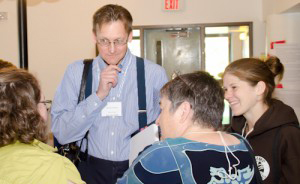 This six session learning resource can be used for self-study, in-person group study, or an online course. Its goal is to deepen understanding of the Quaker way while building community among the participants.
The course focuses on the early history of Friends, the history of Friends in Canada, Quaker testimonies and their origin, and how our Quaker community nurtures how we live, work, worship, and transact business. Although created to meet the needs of more recent attenders seeking to learn more about Quakerism, we believe that even longstanding members could benefit from this course.
Although created to meet the needs of more recent attenders seeking to learn more about Quakerism, we believe that even longstanding members could benefit from this course.
For information concerning the dates of the next course and how to register, email
Course document for self study: Introduction to Quakers & Friends Ways
Ce cours est aussi disponible en français: Introduction aux Quakers
“Uh oh, Was That a Leading?” Course
This is an online course developed by David Summerhays for Canadian Yearly Meeting, which can also be used for face-to-face meetings. The course contains 5 or 6 two-hour sessions, including:
- Exploration of the concept of “leadings”
- Readings and discussion on how early Friends and Friends throughout history have understood “leadings”
- Jokes
- Discernment of what is and what is not a “leading”
- Practice explaining Quakerism to newcomers
- Exploration of what participants learned in the course
There are readings for each session. The full course descriptions, readings and resource materials and facilitator guides are available here:
The course includes worship, storytelling, reflections from readings, and the application to one’s own life of what is learned.
Study of Canadian Yearly Meeting’s Faith & Practice
Published in 2011, Faith & Practice is a collection of writings and quotes selected by Canadian Friends to serve as a living reference of our values, witness, and tradition.
This course was developed by Majory Reitsma-Street and Gale Wills as a tool to explore and study Faith & Practice. It was first used in Vancouver Island Monthly Meeting.
It is available as an online course and a self-study course, which you can access at this link.
“Being Peace, Being Quaker: Walking Through Conflict Together”
Quaker testimonies, discipline, and instruction in faith and practice focus on the positive value of good relationships among us. However, conflicts do arise from time to time, and we hope that Quakers will seek to be faithful in addressing these conflicts and walking through them together.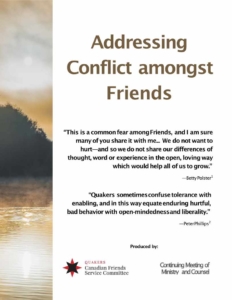
Addressing Conflict Amongst Friends (PDF) is a new resource jointly produced by Canadian Friends Service Committee and Continuing Meeting of Ministry & Counsel. Written specifically for Quaker Meetings, the resource highlights common points of tension and conflict, showing both the challenges and opportunities for growth and deepening of community that they present, if navigated with care.
This booklet highlights that Friends have powerful and successful conflict transformation processes – but they may take time, and so sticking with the process is essential.
It also identifies the centrality of worship in transforming conflicts, shares several stories, and offers multiple approaches that Quaker Meetings have used.
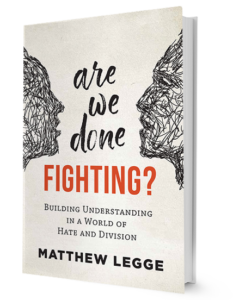
Are We Done Fighting? Building Understanding in a World of Hate and Division is a book that Friends dealing with conflict might also find invaluable. Matt Legge wrote the book as part of his work as program coordinator for the Canadian Friends Service Committee, the service arm of Canadian Quakers.
Are We Done Fighting? collects and shares wisdom from remarkable peacebuilders from all over the world, both Quaker and non-Quaker. It brings together fascinating research findings on how to build peace and understanding, all in an easy format that will helps the reader build practical skills
Are We Done Fighting? offers short chapters full of tips, exercises, and plenty of evidence to explain what’s happening when violence and hate rise, and when peace does.
Here are some other resources that have been developed or collected for Canadian Yearly Meeting, which are offered with the hope that Friends will find them useful:
- Conflict Resource Overview for Canadian Quakers (PDF)
- List of Needs (PDF)
- List of Feelings (PDF)
- Conflict and Struggle in Meetings (PDF) a one-session study guide that was Part 5 of the ‘Friends Ways’ Curriculum (PDF of the guidelines and first 4 units).
- Justice is Possible (PDF) – CYM Minute 79, August 2010
- Extract on dealing with conflict from the Australian Quaker Practice and Procedure Handbook (PDF)
- Dealing with Conflicts in our Meetings (PDF) – Article by Rob Hughes, Vancouver MM
- Conflict Resolution Guidelines (PDF) – from Vancouver MM
- Quakers and Conflict – an oxymoron (PDF)– Article by Susan Robson from The Friends Quarterly
- CYM Conflict Guidelines For Committees (PDF)
- Living faithfully through conflict – the cycle:

Outline of “Being Peace, Being Quaker: A Course on Being in Conflict”
This guide for a 6-part learning session is offered as part of the Canadian Yearly Meeting resources for individual and Meetings in conflict. It is based on Quaker Process and the Non-Violent Communication (NVC) approach developed by Marshall Rosenberg. Those interested in the course can contact .
Session 1:
Welcome and Introduction
– A practical, life-affirming approach to being peace, being Quaker
– Introduction of the Non-Violent Communication approach and link with Quaker faith and practice
Session 2:
Being Peace Being Quaker
– Peace within myself
– Understanding my needs, exploring, inquiring to find them behind feelings and thoughts
– Practicing self-empathy, distinguishing between needs and strategies
Session 3:
Speaking Peace, Speaking Quaker
– Peace with another
– Listening to hear, understanding and acknowledging others’ needs
– Expressing empathy, listening where there’s hurt
Session 4:
Speaking Peace, Speaking Quaker
– Peace with another
– Speaking truth without judgment, seeing the unmet needs behind thoughts and expressions of judgment, making requests (not demands) of others
Session 5:
Living Peace, Living Quaker
– Answering that of God – in self and in others
– The power of empathy, sustaining a practice of Spirit-led, peace-full communication
Session 6:
Living Peace, Living Quaker
– Peace where others are in conflict,
or there is a difficult question without resolution
– What would Love have us do? How do we support others in listening, in speaking truth with compassion?
– How do we contribute to moving through conflict in the Blessed Community?
Learning at CYM in Session
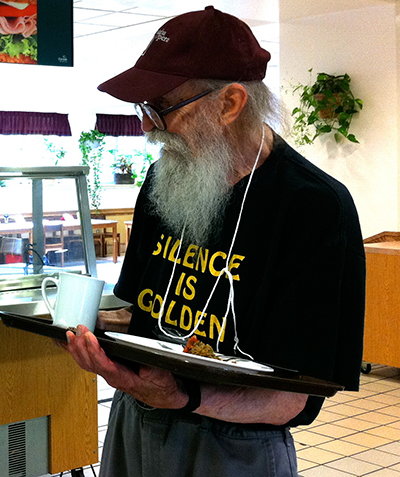 Canadian Quakers gather annually for CYM in Session, where there are many opportunities for learning
Specific information will always appear on the coming year’s program (once it’s available), but here are typical examples of learning opportunities at the yearly gathering:
- Pre-gathering retreats – sometimes silent retreats, sometimes on specific topics
- Welcoming and gathering activities that involve learning more about our community and who we are as Friends
- The Sunderland P. Gardiner Lecture – a kind of keynote address, usually sharing wisdom from a seasoned Friends on how Spirit has moved in their lives. For the audio and video of some past lectures, go to quaker.ca/resources/audio-and-video
- The Quaker Study or Bible Study – 4 or 5 daily sessions on specific topics of interest to Friends. Again, for audio and video of past studies, go to quaker.ca/resources/audio-and-video
- Workshops on topics like welcoming first-timers, leading worship-sharing or worship-study groups, the role of Listeners at CYM in Session, and training for those working with youth
- Special Interest Groups (SIGs) offered by a number of Friends or Committees. Past SIGS have included: presentations on local service projects, dealing with conflict, writing, collage, playshops, visitation, clerking Meeting for Worship for Business
- Age-appropriate, engaging learning and play activities for children and youth
- Sometimes we learn just by being in the presence of our elders.